
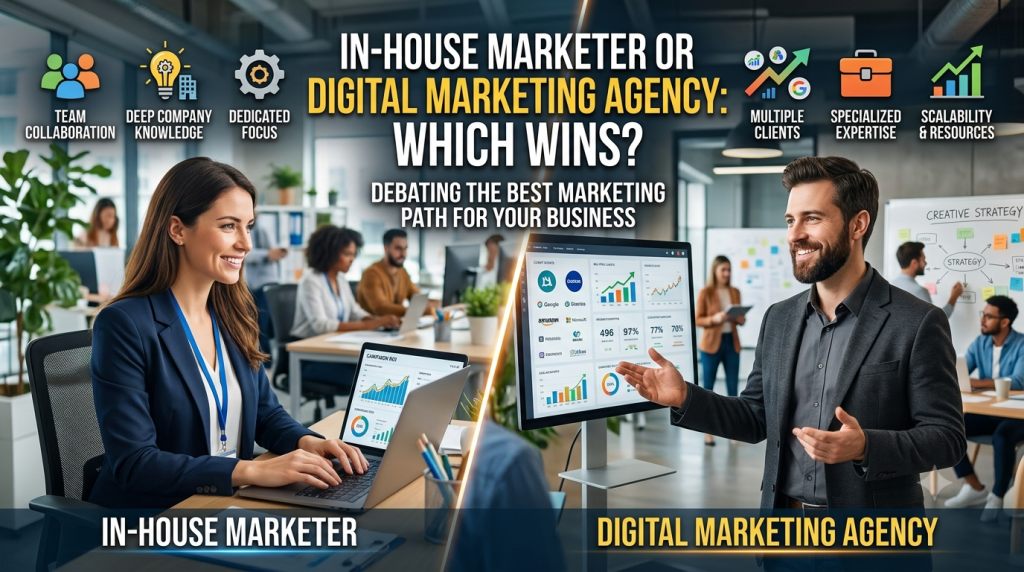
Should you hire an in-house marketer or a digital marketing agency? Compare cost, expertise, control, flexibility, scalability, and results to choose the best marketing model for your business.
Choosing between an in-house marketer and a digital marketing agency is one of the most important decisions a growing business can make. Your choice affects your budget, brand consistency, campaign speed, access to expertise, and ability to compete online.
The honest answer is that neither option wins in every situation. An in-house marketer may be the better choice when your business needs deep brand knowledge and close collaboration. A digital marketing agency may be more effective when you need specialist skills, faster execution, or flexible support. For many businesses, a hybrid model combines the strengths of both.
This guide compares the two options and explains how to choose the right approach for your goals.
What Is an In-House Marketer?
An in-house marketer is an employee who works directly for your business. Depending on your size and budget, this person may handle strategy, content, social media, email marketing, search engine optimization, paid advertising, reporting, or coordination with external suppliers.
Larger companies may build a complete internal department with specialists such as:
- Marketing manager.
- SEO specialist.
- Content strategist.
- Paid media manager.
- Social media manager.
- Designer.
- Marketing analyst.
- Marketing automation specialist.
The main advantage of an in-house team is proximity. Internal marketers work closely with leadership, sales, customer service, product teams, and other departments. Over time, they develop a detailed understanding of your brand, audience, products, processes, and commercial priorities.
However, one person cannot usually be an expert in every digital marketing discipline. SEO, paid advertising, content, design, analytics, email automation, and conversion optimisation each require different skills. A small internal team may therefore have strong brand knowledge but limited specialist coverage.
What Is a Digital Marketing Agency?
A digital marketing agency is an external company that provides marketing services for a fee. The agency may work on a monthly retainer, a fixed project, an hourly basis, or a combination of pricing models.
Depending on the agency, you may gain access to:
- Marketing strategists.
- SEO specialists.
- Copywriters.
- Paid advertising managers.
- Web developers.
- Designers.
- Social media professionals.
- Data and analytics experts.
- Conversion rate specialists.
Agencies range from small specialist firms to large full-service organisations. Some focus on one service, such as SEO or paid media, while others manage an entire digital marketing programme.
An agency can provide a broader range of skills without requiring you to recruit, train, and retain every specialist internally. It can also bring experience from working with different industries and business models. However, an agency must learn your brand, internal processes, customer expectations, and approval requirements.
In-House vs Agency
| Factor | In-house marketer | Digital marketing agency |
|---|---|---|
| Brand knowledge | Deepens through daily involvement | Requires onboarding and ongoing communication |
| Cost structure | Fixed salary, benefits, tools, and training | Retainer, project fee, or variable cost |
| Expertise | Limited to the skills you hire | Access to multiple specialists |
| Control | Direct daily control | Managed through communication and agreements |
| Scalability | Requires additional hiring | Scope can often increase or decrease |
| Communication | Direct access to an internal colleague | Regular meetings, reports, and account management |
| Perspective | Strong internal knowledge | External ideas and cross-client experience |
| Continuity | Risk if an employee leaves | Agency provides team coverage, but staff may change |
| Tools | Your business pays for software | Some tools may be included in the agency fee |
| Best suited to | Long-term brand ownership and close collaboration | Flexible expertise and faster multi-channel execution |
The Cost Question
Cost is often the first factor businesses consider, but comparing only a salary with an agency fee can produce an inaccurate result.
An in-house marketer’s total cost may include:
- Salary.
- Employer taxes and benefits.
- Recruitment fees.
- Onboarding time.
- Equipment.
- Training.
- Marketing software.
- Management time.
- Freelancers or consultants for missing skills.
- Recruitment costs if the employee leaves.
A single internal marketer may be cost-effective when your needs are narrow and consistent. For example, a local company that mainly needs social media management, email newsletters, and basic content may not require a large agency.
The cost calculation changes when you need several disciplines. Hiring separate specialists for SEO, paid advertising, content, design, analytics, and marketing automation can create significant fixed expenses. Recent industry comparisons note that agencies often provide access to multiple specialists at a more flexible cost than building an equivalent team internally, although actual pricing varies by scope, market, and agency experience.[hoopinteractive][webfx]
Agency pricing may include:
- Strategy.
- Account management.
- Campaign execution.
- Reporting.
- Creative production.
- Specialist expertise.
- Software access.
- Testing and optimisation.
This does not mean an agency is always cheaper. A long-term agency retainer can become expensive, especially when your business needs daily internal support or extensive custom work. Compare the total cost of the skills and output you require, not simply the monthly invoice.
The Case for In-House Marketing
Deep brand understanding
An internal marketer lives with your brand every day. They learn your tone of voice, customer questions, product details, sales process, and company culture. This knowledge can make content more accurate and approvals faster.
Direct collaboration
An employee can join internal meetings, speak directly with sales and product teams, and react quickly to changes. If a product feature changes in the morning, the marketer may be able to update a campaign without waiting for an external briefing.
Stronger internal ownership
In-house marketing often creates a closer connection between marketing and the rest of the business. Internal employees may have easier access to customer feedback, operational data, and leadership decisions.
Long-term institutional knowledge
Over time, an internal marketer can build a valuable record of what the company tried, what worked, what failed, and why. That knowledge remains within the business, provided it is documented and shared.
Limitations of In-House Marketing
Narrow specialist coverage
A generalist may manage many channels but lack advanced expertise in one or more areas. Digital marketing platforms, analytics systems, search practices, and advertising policies change regularly, so maintaining expertise requires time and investment.
Recruitment and retention challenges
Finding a skilled marketer can take weeks or months. If a key employee leaves, campaigns may slow down and important knowledge may disappear with them.
Fixed capacity
An internal marketer has a limited number of working hours. A product launch, seasonal campaign, website redesign, or new market entry may exceed the team’s available capacity.
Internal perspective can become narrow
Working exclusively on one brand provides depth but may reduce exposure to ideas from other industries. A team can become accustomed to existing processes and overlook new opportunities.
The Case for a Digital Marketing Agency
Access to specialists
An agency may give you access to people who focus on specific disciplines. This can be useful when your growth depends on technical SEO, paid media, conversion optimisation, marketing automation, or data analysis.
Faster scalability
Agencies can often increase support for a launch or seasonal campaign without requiring you to recruit permanent employees. They can also reduce the scope during quieter periods, subject to the contract.
External perspective
An agency can identify problems that internal teams may overlook. Because agencies work across different businesses, they may bring fresh ideas about content, customer journeys, creative testing, and campaign structure.
Established systems and processes
A reputable agency should already have project-management systems, reporting processes, campaign workflows, and quality checks. This can reduce the time needed to build a marketing operation from scratch.
Flexible access to tools
Some agencies invest in specialist software for keyword research, analytics, competitive analysis, reporting, design, or testing. Depending on the agreement, you may benefit from these tools without purchasing every platform separately.
Limitations of an Agency
Onboarding takes time
An agency cannot understand your business instantly. It needs access to your website, analytics, customer information, brand guidelines, sales data, and internal stakeholders.
Less direct control
You remain responsible for strategic decisions, but day-to-day work happens outside your organisation. Success depends on clear communication, timely approvals, and a well-defined scope.
Variable quality
The agency’s reputation alone is not enough. Ask who will actually work on your account, how experienced they are, and how much senior involvement you will receive.
Competing priorities
An agency may manage several clients. Before signing, clarify expected response times, meeting schedules, team availability, and escalation procedures.
When In-House Is the Better Choice
An in-house marketer may be the stronger option when:
- Your marketing needs daily internal coordination.
- Your products are complex or highly specialised.
- Your brand voice is central to customer trust.
- You need rapid access to product and sales teams.
- Marketing is a permanent core function.
- You have enough budget to build and retain the required skills.
- You can provide ongoing training and modern tools.
- Your strategy depends on proprietary customer or operational data.
For example, a software company launching frequent product updates may benefit from an internal content or product marketing manager who works closely with engineering, sales, and customer success.
When an Agency Is the Better Choice

An agency may be more suitable when:
- You need results without building a full department.
- Your team lacks SEO, paid media, analytics, or creative expertise.
- You want to launch campaigns quickly.
- You are entering a new market.
- Your workload changes throughout the year.
- You need an independent review of your current strategy.
- You want access to specialists and established tools.
- You need help with a specific project or channel.
For instance, a growing online retailer may retain an agency for technical SEO, paid shopping campaigns, landing-page testing, and analytics while an internal employee manages merchandising and customer communications.
The Hybrid Model
For many businesses, the best answer is not “in-house or agency.” It is a combination of both.
A hybrid model might include:
- An internal marketing manager who owns priorities and brand direction.
- An agency that manages SEO and paid advertising.
- Internal staff who provide product knowledge and customer insights.
- External specialists who support web development, design, or analytics.
- A shared reporting system with agreed performance metrics.
The internal team acts as the strategic owner, while the agency provides additional capacity and specialist execution. This arrangement can offer stronger brand alignment than a fully outsourced model and broader expertise than a small internal team.
The hybrid model requires clear responsibility. Define who approves content, owns accounts, manages budgets, reports results, and makes final decisions. Without clear ownership, tasks may be duplicated or neglected.
How to Make the Decision

Use this five-step process:
- Define your business goals and the marketing channels required.
- List the skills, tools, and weekly capacity you need.
- Calculate the total cost of hiring internally, not only the salary.
- Compare agencies using case studies, references, pricing, reporting, and team quality.
- Consider a short project or pilot before making a long-term commitment.
Do not select an agency solely because it promises guaranteed rankings or immediate results. Search engines aim to show helpful, reliable, people-first content, and Google advises businesses to create content primarily for users rather than manipulate search rankings. Sustainable marketing depends on useful content, sound strategy, accurate measurement, and continuous improvement.
Final Verdict
There is no universal winner in the in-house marketer versus digital marketing agency debate. In-house marketing wins on brand immersion, direct collaboration, and long-term ownership. An agency wins on specialist expertise, flexibility, scalability, and external perspective.
Choose in-house when marketing is deeply integrated into your daily operations and you can support the necessary talent. Choose an agency when you need broader expertise, faster execution, or flexible access to specialists. Choose a hybrid model when you want internal ownership with external support.
The best decision is the one that connects people, budget, technology, and strategy to measurable business goals. Focus less on the label and more on whether the marketing function can consistently understand your customers, deliver useful experiences, learn from reliable data, and improve over time.
